
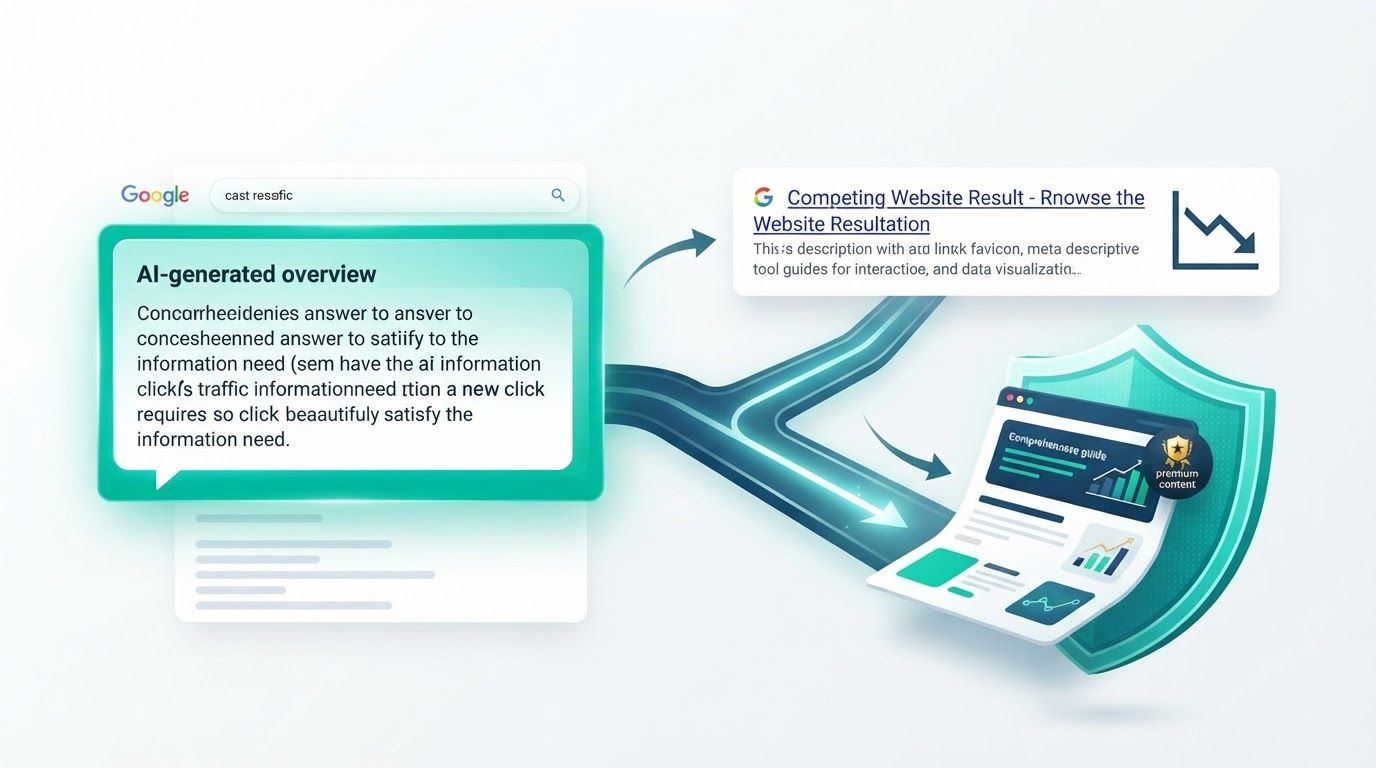
If an AI Overview answers a travel question before someone visits your site, a useful page may lose the click it once earned. To protect traffic from AI Overviews, travel publishers need pages that help readers make decisions an AI summary cannot settle: what to prioritize, what to verify, and how to plan an experience that fits their interests.
For a Sindh travel and heritage blog, that means keeping practical information easy for search engines to access while making each article worth opening after a quick answer. A short description of Makli may satisfy a broad query; a carefully researched guide to approaching its history, planning a photography visit, and checking current visitor details gives a traveler a reason to continue. The aim is not to force every search into a click. It is to earn the clicks that lead to engaged readers, useful trip planning, and a recognizable publication they may return to.
What it means to protect traffic from AI Overviews
AI Overviews change where some search journeys begin. A reader who once opened several pages to learn what a place is may now get a workable definition on the results page. That does not make the entire journey disappear: deciding which heritage sites to visit, how to allocate limited time, or what questions to ask before traveling still calls for more detail than a brief response can comfortably provide.
Direct answer: Protect traffic from AI Overviews by making your pages crawlable, publishing distinctive firsthand or carefully verified information, and targeting travel decisions that need more than a short summary. Track whether search visitors reach and use those pages, then build repeat discovery through clear source identity and other audience channels.
The pressure is substantial, but it is easy to misuse the numbers. Google has said AI Overviews has more than 2.5 billion monthly active users, while AI Mode has surpassed 1 billion monthly users. Comscore reported AI Overviews in 39.4% of U.S. desktop searches in June 2026, compared with 25.8% in July 2025. Those figures show scale and growth in the measured setting; they do not tell a Sindh publisher what share of its own queries triggers an AI answer.
The broader zero-click pattern is also worth understanding without treating every lost click as an AI Overview loss. SparkToro's coverage of Similarweb panel data reported that 68% of U.S. Google searches in June 2026 ended without a click and that 232 of every 1,000 sent a click to the open web. Many search journeys can end on Google for reasons besides AI. Use such research to frame the risk, then use your own page and query data to make editorial decisions.
Other findings point in the same general direction while measuring different things. Search Engine Land reported Define Media Group's finding of a 42% drop in organic search clicks across 64 sites as AI Overviews expanded. A 2026 randomized field experiment found that forcing users into AI Mode reduced external-site visits by 18.8 percentage points compared with normal Google use, with news-site clicks down 12.5 points. Neither result should be presented as a forecast for every travel blog. Both reinforce a practical conclusion: a publishing plan based solely on winning the initial informational click is exposed.
Identify which Sindh travel queries still need a visit
The first editorial step is to separate questions an AI answer can resolve from questions that open a larger decision. Someone asking what Makli is may only want an orientation. Someone deciding whether Makli fits a heritage-focused itinerary around Thatta may want context, priorities, images, preparation, and links to information they can check before leaving. The second question gives a well-made article more work to do.
Review the queries and pages that already bring people to your site. Group them by the reader's next action rather than by keyword wording alone:
- Quick identification: The reader wants a name, location, or short explanation. A concise page section can serve this need, but it may not reliably produce a visit from search.
- Choice: The reader is deciding between places, routes, seasons, or types of experience. A comparison grounded in clearly stated criteria can add value beyond a compact answer.
- Preparation: The reader wants to know what to confirm, pack, photograph, read, or discuss with a local guide. A transparent checklist can be useful without pretending that changing visitor conditions are permanent.
- Deeper understanding: The reader wants the cultural or historical significance behind what they will see. Good interpretation, with clear distinctions between documented information and editorial observation, rewards attention.
- Return or sharing: The reader enjoyed an article and wants more from the same voice. A coherent series and an easy path to related stories make one search visit less isolated.
That classification prevents a common mistake: trying to make every article longer without giving it a clearer purpose. A sprawling introduction to the heritage of Sindh can still be easy to summarize. A focused guide on how to plan a respectful visit to a particular site can answer a more demanding question, provided it contains specific, useful guidance rather than padding.
Build the next step into the page
For each important query, write down what the traveler might ask after receiving a short answer. If the first question is about Ranikot, the next may concern how to assess the effort involved in a visit, what kind of landscape photography to expect, and which current access details require confirmation. If the first question is about Mohenjo-daro, the next may be how to prepare to understand the site rather than simply recognize its name.
These are editorial angles, not permission to invent logistics. Where transport, opening arrangements, permissions, weather, or site conditions can change, say what a visitor needs to verify and point them toward an appropriate current source when you have one. A reader gains more from a clearly bounded guide than from precise-looking details that have not been checked.
Choose pages for improvement by combining their relevance to your audience with evidence of search exposure and a genuine opportunity to add depth. A page attracting impressions for planning-related searches but receiving few clicks may deserve a sharper title and more decision-supporting material. A page whose search demand is mostly a simple definition may be better kept concise and connected to richer guides, rather than expanded into an artificial long read.
Publish original travel content an AI summary cannot replace
Google's AI-search guidance emphasizes valuable, unique, people-first content rather than generic summaries. For a travel publication, originality does not require a dramatic claim of exclusive access. It can come from a documented visit, a carefully framed photographic observation, an informed explanation of what a visitor can notice, or a practical account of how an itinerary was evaluated.
A generic article might list famous Sindh landmarks and give each a few interchangeable sentences. A stronger piece tells a reader why particular stops belong together, which interest each one serves, and what remains uncertain until current details are checked. The difference is not merely more words. It is evidence of editorial judgment that helps a real person choose.
Show the basis for your guidance
Experience is most persuasive when the page makes its limits visible. If an author visited a location, describe observations as observations and identify when they were made if that context matters. If the writer has not visited, do not imply firsthand knowledge; explain that the guide is based on reviewed material and distinguish established historical background from practical recommendations that still need local confirmation.
For heritage coverage, separate interpretation from logistics. A paragraph explaining why a site matters culturally should not quietly imply that a particular visitor route is currently open. A photography suggestion can describe an approach to composition without promising unrestricted access to a monument. These distinctions make the writing more useful and build trust with readers who may act on it.
Consider adding elements that genuinely help a traveler use the page:
- An itinerary rationale: Explain why the suggested sequence suits a history enthusiast, a photographer, or a traveler with limited time, rather than presenting one route as right for everyone.
- A looking guide: Identify features, themes, or questions worth noticing at a site, with historical claims checked before publication.
- A practical verification note: State which visit details can change and where the reader should seek the latest information when a reliable source is available.
- Original visuals with context: Caption photographs so they clarify what the reader is seeing; do not use an image as decoration when it could help explain the place.
- Useful trade-offs: Discuss what a proposed plan emphasizes and what it leaves out, so readers can adapt it to their interests.
AI can assist with drafting or organizing research, but it cannot turn unverified travel claims into experience. Google's guidance recommends providing context for AI-generated content and manually fact-checking it before publication. An editor should check names, historical descriptions, geographic relationships, captions, and any practical guidance that might affect a trip. If a detail cannot be confirmed, remove it or describe the uncertainty plainly.
Originality also has a maintenance cost. A richly detailed planning guide may attract more qualified readers, but its time-sensitive sections need review. An evergreen cultural essay may require fewer logistics updates while serving a different need. A healthy editorial mix uses each format for what it does well instead of asking a single article to be a history lesson, transport notice, photography manual, and current-access bulletin all at once.
Keep heritage guides crawlable and easy to understand
Even an outstanding article cannot appear through Google Search features if search systems cannot access and process it appropriately. Google's guidance for AI features remains foundation first: follow core SEO best practices, make content publicly accessible and crawlable, and publish helpful, reliable pages that comply with Search policies. It describes no separate shortcut that replaces sound technical SEO.
Start with the pages you most want travelers to find. Open them as an ordinary visitor would, including on a phone. Confirm that the main text is available without an account or unnecessary barrier, that important internal links work, and that the page can be reached from the site's navigation or related articles. Then use your available search and site tools to investigate indexing issues rather than assuming a published page is discoverable.
- Check access and indexing: Review whether important URLs can be crawled and whether accidental blocks, redirects, or canonical choices are keeping the intended page out of Search.
- Make the page's purpose unmistakable: Give each guide a descriptive title and clear ings. A traveler and a search system should both understand whether the page is an introduction, an itinerary, or a planning resource.
- Keep essential information in readable page content: Do not rely on an image or decorative graphic alone to carry the explanation of a place or the steps in a route.
- Review what appears around the page: Check the title, meta description, image alt text, and any structured data you use for accuracy. Google's guidance notes that these elements can appear in Search results and should be high-quality and manually reviewed.
- Connect related resources: Link from broad destination pages to specific site guides and from individual guides to genuinely useful next reads. Use link text that tells readers what they will find.
For Tour Sindh, a broad article about heritage travel can introduce themes and lead naturally to deeper pieces on individual places. An article focused on Thatta can point to a Makli guide when the connection helps the reader continue planning. Internal links should create a usable path, not a web of repetitive keyword anchors.
Structured data deserves care rather than enthusiasm for its own sake. Use it only when it accurately describes visible content and follows Google's applicable requirements. It cannot compensate for an inaccessible page, a misleading title, or a thin article. Likewise, revising alt text should improve the description of an image, not turn every photograph into a keyword list.
Technical fixes and editorial improvements are alternatives only when time is scarce; in a durable strategy, they work together. If a strong article is blocked from indexing, resolve that first. If a page is fully accessible but gives readers nothing beyond a generic summary, a technical audit alone will not make it distinctive. Prioritize the bottleneck that is actually preventing the page from doing its job.
Make source links worth choosing after the answer
An AI response can cite or link to the web, but a source link still has to compete for the reader's attention. Google said in October 2026 that it was increasing inline links in AI responses, adding clearer source links, and testing a dedicated links section near the top of responses. Those changes create opportunities to be discovered, not a promise that every linked publisher will receive meaningful traffic.
Think of the moment after the short answer. A traveler has learned that a place exists; why should they open your guide? The answer should be clear from the page title, the likely search-result description, and the first screen of content. A specific promise such as helping the reader understand what to look for, compare two possible visits, or plan questions to verify is more compelling than a broad claim to be the ultimate guide.
Match the link promise to the landing page
If a search result suggests a focused planning article, the landing page should deliver that focus immediately. Place the core decision early: who the guide is for, what it covers, and what it does not settle. Then provide a skimmable route through the detail. Clear ings and purposeful internal links let a traveler continue without wading through repeated introductions.
For example, a page about photographing a Sindh heritage site could lead with the kind of visual and historical considerations it covers, followed by a section on respectful practice and a note to verify current site rules. A page about planning a heritage-focused day could lead with the interests it serves, then explain the reasoning behind its suggested stops. Neither page needs to pretend that one itinerary or camera approach fits everyone.
Page identity matters as much as a clever line. Keep the publication name visible, use an informative author or editorial attribution where appropriate, and make it easy to find related Tour Sindh coverage. If a reader recognizes a reliable source in an AI response today, that recognition may help them choose the source again later. The immediate click remains valuable, but so does a reader who begins to look for your publication by name.
Avoid optimizing solely to be quoted. A page made of disconnected short answers may be easy to extract from, yet give readers little reason to continue. Concise definitions and direct answers can help orientation; surround them with the context, judgment, imagery, and planning support that make a visit worthwhile. The goal is to be a useful source both within a short response and beyond it.
Measure search traffic without overclaiming AI losses
Measurement should answer a practical question: which pages still attract the right visitors, and what do those visitors do next? Google says clicking an external link inside an AI Overview counts as a click in Search Console, and the AI Overview itself occupies one position in Search Console reporting. A click from that surface is therefore not invisible simply because the result looked different from a classic blue link.
At the same time, a change in search clicks is not proof of one cause. Rankings, demand, page changes, competing results, travel interest, and the appearance of AI features can all affect outcomes. Search Console is useful for page and query trends, but avoid treating an average position or a click decline as a clean, standalone measure of AI Overview exposure.
Google announced a new Search Console control and performance insights for AI in Search in June 2026. If relevant reporting is available to your property, inspect what it actually shows and use it alongside established Search Console and site analytics data. Do not build an editorial dashboard around a distinction your available reports cannot reliably make.
- Establish a page-level baseline: Record search impressions, clicks, and click-through patterns for important guides before making substantial changes. Note the queries that show planning intent rather than only broad curiosity.
- Track meaningful on-site behavior: Look for signs that visitors read the guide, follow related links, or reach another useful page. Choose measures your analytics setup can collect responsibly.
- Annotate editorial changes: Record when you improve a title, add verified observations, refresh an itinerary, or fix an indexing issue. This gives you context when performance moves.
- Compare like with like: Review similar pages and query types over sensible periods, accounting for seasonality and uneven search demand where possible.
- Decide what to do next: Expand a guide that attracts engaged planning readers, repair a page with an access problem, or rethink one whose promise earns clicks but fails to serve the visitor.
A useful distinction is traffic volume versus traffic value. A brief fact page might receive many casual visits without leading anyone deeper into the site. A narrower guide could draw fewer visitors who read, explore related stories, or use the material to plan. Neither outcome is automatically superior: it depends on whether the publication wants awareness, loyal readership, trip-planning engagement, or a combination.
Google Discover and Google News may also matter for some publishers. In the Define Media Group findings reported by Search Engine Land, breaking-news traffic rose in those surfaces while organic search clicks fell across the studied sites. That does not mean a heritage blog should become a breaking-news operation. It means search performance should be viewed alongside other relevant discovery channels, with the publication's strengths and audience needs guiding where effort goes.
Build repeat readership beyond a single search click
A site that depends on a fresh generic search for every visit is especially vulnerable when answers stay on the results page. Repeat discovery offers a different path: readers learn what a publication covers, trust its standards, and return when they have another question about Sindh. That requires a clear editorial identity, not merely more channels to post into.
Google brought Preferred Sources into AI Overviews and AI Mode in May 2026, allowing users to surface favorite publishers more prominently in AI Search. The feature creates an opportunity for recognizable publications, but it is not a switch a site owner can flip to guarantee preference. The sensible response is to give interested readers reasons to remember and choose Tour Sindh: consistent coverage, recognizable authorship, accurate details, and well-organized paths to related stories.
Make returning easy within the site itself. If someone arrives for a Makli article, a carefully selected next read about the wider Thatta area or Sindh's heritage themes may be more helpful than an unrelated list of popular posts. A photographer might appreciate a linked series on observing architecture and landscape; a history enthusiast may prefer context on the periods, places, and questions raised by a visit. Label these routes clearly so readers can decide for themselves.
Channels you control can complement search if you can maintain them. An email update, for example, is useful when it offers a genuine reason to subscribe, such as new researched guides or thoughtful photo essays. A social post can introduce an article through a strong image and an honest description of its value. Neither channel should be treated as a guaranteed replacement for search traffic; each asks for sustained editorial work and should be judged by the audience it actually serves.
Partnerships and citations also need an audience-first test. If a museum, cultural organization, travel community, or local expert has a legitimate reason to share a carefully researched guide, that can help the right people discover it. Do not turn heritage coverage into link acquisition at the expense of accuracy or independence. Trust is particularly important when writing about places whose significance extends far beyond their usefulness as search topics.
For a small publication, focus matters. It is better to build a dependable cluster of Sindh guides and one repeat-readership channel that you can maintain than to scatter effort across every platform. The objective is resilience: a reader can find you through Search, recognize you in an AI source link, follow a related article, or come back directly because the previous visit was worthwhile.
Prioritize improvements your editorial team can sustain
The best defense is not a wholesale rewrite prompted by every change to the search results page. It is a repeatable process for finding your strongest opportunities, improving them, and keeping them accurate. Start with a small group of pages that already relate to real traveler decisions, then make one clear improvement to each before expanding the program.
Choose work by impact and upkeep
A practical first pass has four possible outcomes. If a valuable guide cannot be accessed or indexed properly, fix that obstacle. If it appears in search but gives only broad facts, add verified detail that helps someone choose or prepare. If its content is strong but its title is vague, make the promise clearer without overselling. If its advice depends on changing arrangements you cannot maintain, narrow the claim and tell readers what to confirm.
Give each improvement an owner and a review path. A heritage explanation and a travel-logistics note do not age at the same rate. Keep durable historical context separate from details likely to change, so an editor can update the latter without having to reconsider the whole article. When a page includes original images, check that captions, alt text, and surrounding prose still describe them accurately.
Before publishing or refreshing a guide, ask a short set of editorial questions:
- What decision or deeper question does this page help a traveler address after a quick search answer?
- Which claims are based on direct observation, which come from research, and which practical details need current confirmation?
- Can a reader reach the useful material quickly and continue to a relevant next page?
- Does the title accurately describe the guide without promising information it does not provide?
- Can the team maintain any time-sensitive guidance included here?
These questions also help when deciding what not to publish. An article assembled from generic descriptions of attractions adds little to an already crowded search result. A speculative update about visitor arrangements may be worse than no update at all. Investing that time in a narrower, better-supported article can produce a more useful resource for both travelers and the publication.
Keep experimentation proportional. Test clearer introductions, more descriptive titles, stronger internal routes, or additional firsthand context on selected pages, then review the results before applying the same change everywhere. Some informational articles will continue to earn clicks; others may function better as concise entry points to deeper coverage. Let the role of each page reflect what readers need, not an assumption that every query must produce the same kind of visit.
AI Overviews can answer the opening question, but they do not remove a traveler's need to choose, prepare, and understand what they are visiting. Protect traffic by making Tour Sindh's pages accessible and accurate, then giving readers a distinctive reason to move beyond the short answer: grounded heritage context, transparent planning guidance, and an editorial voice they can trust.
Begin with the guides closest to a real trip-planning decision. Check that they can be found, strengthen what makes them useful, and measure whether visitors continue exploring. The durable goal is not to recover every click to a simple fact; it is to make each earned visit worth taking and worth remembering.